
University Financial Associates (UFA) LocationScore offers data-driven predictions of loan risk and performance tied to geography. Rather than measuring individual creditworthiness, this metric assesses risks driven by local economic and demographic conditions—such as default likelihood, prepayment trends, and long-term loan value—often at the ZIP code or regional level.
 Who Uses LocationScore?
UFA's LocationScore tool serves multiple audiences by enhancing financial decision-making and credit risk modeling:
- Lenders: Avoid lending in high-risk areas and optimize regional strategy.
- Investors: Assess risk exposure in securitized loan packages.
- Insurers: Strengthen underwriting with localized economic intelligence.
 Key Benefits of UFA’s LocationScore
Using geographic data provides a richer context for financial assessments. Here’s how our tool empowers smarter decisions:
- Risk and opportunity detection: Spot high-risk or high-reward lending regions before issuing loans.
- Smarter underwriting: Complement traditional criteria (credit score, income, assets) with regional factors like job stability, property trends, and economic shifts.
- Portfolio strength: Reduce charge-offs, support predictable returns, and increase investor confidence through strategic area targeting.
 How LocationScore Is Created
Our scoring system analyzes key geographic variables to project loan outcomes:
- Economic indicators: Employment rates, income trends, collateral forecasts, and business activity.
- Demographics: Population growth, education levels, age distribution, and more.
- Lifestyle metrics: Crime rates, school quality, access to amenities, health metrics and local infrastructure.
By synthesizing this data, UFA generates actionable insights that support precision forecasting and stronger credit risk models.
LocationScore also helps identify demographic and regional economic patterns—such as shrinking populations or disaster-prone zones—that might impact loan performance. Lenders can proactively reduce exposure and enhance pricing accuracy while building diversified portfolios across stable and growth-oriented neighborhoods.
📈 Applications for Lenders & Investors
LocationScore can be leveraged across several lending and investment scenarios:
- 🧮 Default Risk: Understand the probability of loans defaulting in a specific area based on economic conditions, historical data, and income stability.
- ⏩ Prepayment Risk: Evaluate whether borrowers in a region may repay loans early—impacting returns—based on interest trends and housing market projections.
- 💰 Loan Value: Analyze how geographic factors influence long-term loan value, enabling focus on regions with high return potential and value stability.

UFA LocationScore™ Default
UFA LocationScore™ Default
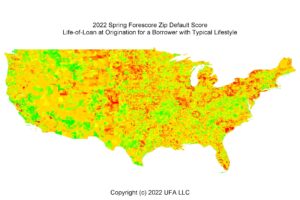 UFA LocationScore™ Default takes your credit evaluation to a whole new level. UFA LocationScore™ Default is usually the second or third most important variable in credit analysis, similar in impact to credit and loan-to-value.
How It Works UFA uses large loan datasets to assess the location effects on loan performance of future economic conditions, demographics, environmental conditions, and lifestyle variables.
For more information on how the ForeScore™ tools can help your organization, please contact:
University Financial Associates LLC
Email: info@ufanet.com
Phone: (734) 995-7271
UFA LocationScore™ Value
UFA LocationScore™ Value
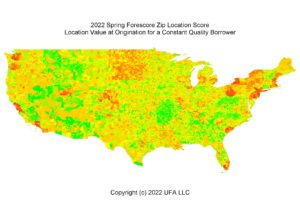 UFA LocationScore™ Value takes your loan and pool valuation to an amazing level. The cash flow estimates in LocationScore™ Value enable you to determine the differences in profitability in each location.
How It Works UFA forecasts the future cash flows on a loan based on economic conditions, demographics, environmental conditions, and lifestyle variables. The future cash flows on a loan when combined with the current cost of funds provide the differences in the profitability of a loan at each location. On any given date, these profitability differences can be twenty percent of loan value. Between origination dates profitability can vary by even more... up to fifty percent of loan value!
For more information on how the ForeScore™ tools can help your organization, please contact:
University Financial Associates LLC
Email: info@ufanet.com
Phone: (734) 995-7271
LocationScore FAQ
Credit risk modeling builds statistical tools to estimate default probability and losses, while credit risk assessment is the broader decision-making process that combines those model outputs with human judgment to evaluate a borrower's creditworthiness.
Credit risk modeling creates data-driven tools that produce standardized metrics like probability of default (PD), loss given default (LGD), and exposure at default (EAD). These models use techniques such as logistic regression, credit scorecards, or machine learning trained on credit histories, financial statements, and economic data. Risk analytics teams use these validated, repeatable outputs to inform pricing, provisioning, and regulatory capital requirements.
Credit risk assessment is what credit officers and underwriters actually do when making lending decisions. They take model-generated scores and combine them with qualitative factors—management quality, industry conditions, business model strength, collateral value, and market risks. This judgment-intensive process results in actionable decisions: loan approvals or declines, credit limits, pricing terms, and covenants.
In short, modeling provides the analytical tools, while assessment uses those tools plus human expertise to make final credit decisions.
Geographic data improves credit risk accuracy by capturing location-specific economic conditions and default patterns that borrower-level data alone misses. It strengthens fraud detection, enables better portfolio management, and helps lenders safely extend credit to thin-file borrowers.
Enhances predictive models
Geographic information allows models to incorporate local economic factors that drive default risk:
- Regional unemployment rates and job market conditions
- Property values and housing market trends
- Neighborhood income levels and economic stability
Spatial modeling shows how risk clusters geographically—a borrower in a high-default area carries higher modeled risk even with a strong personal profile. Research proves that adding neighborhood characteristics and spatial patterns significantly increases correctly forecasted defaults, improving both probability of default (PD) and loss given default (LGD) estimates.
Improves credit decisions
Geographic tools help credit officers make smarter decisions:
- Risk heat maps reveal emerging problem areas for targeted underwriting adjustments
- Portfolio concentration reports identify overexposure to vulnerable regions
- Neighborhood indicators provide context for thin-file borrowers when credit history is limited
This location-based approach is especially valuable in underserved markets, enabling lenders to safely approve more borrowers while maintaining quality.
Strengthens fraud prevention
Geographic verification improves data reliability:
- Confirms stated addresses match actual locations via IP or mobile data
- Flags identity fraud when location data doesn't align
- Detects suspicious patterns like application clusters from the same area
By improving both model inputs and decision-making context, geographic data makes credit risk management more accurate, inclusive, and secure.
Default and prepayment risk models use overlapping but distinct factors. Default models focus on ability and willingness to pay, while prepayment models emphasize economic incentives to refinance or repay early.
Borrower-level factors
For default risk:
- Credit history – credit scores, past delinquencies, bankruptcies, and credit history length
- Financial health – income, debt-to-income ratio, cash flow, and credit utilization
- Demographics – age, employment status, and repayment behavior patterns
For prepayment risk:
- Higher credit scores and income levels (these borrowers refinance more readily when rates drop)
- Liquidity and ability to pay down principal early
Loan and collateral characteristics
Both models rely heavily on loan terms:
- Contract details – interest rate, maturity, amortization schedule, and prepayment penalties
- Loan structure – fixed vs. variable rates, loan-to-value ratio (LTV), and collateral quality
High LTV and weaker collateral increase default risk. Prepayment models especially track the refinancing incentive—the gap between the borrower's current rate and market rates—since this drives early payoff decisions.
Economic and market conditions
Macro factors affect both risks:
- Economic indicators – unemployment, GDP growth, income trends, and property values (defaults rise in recessions)
- Interest rate environment – falling rates typically reduce defaults but increase prepayments, especially on fixed-rate loans
- Credit spreads – market pricing of credit risk
Corporate-specific factors
For business borrowers, models add:
- Financial ratios – profitability, leverage, interest coverage, and liquidity
- Market signals – equity prices, volatility, and debt valuations
In summary, default models prioritize solvency and payment capacity, while prepayment models focus on refinancing incentives, particularly the difference between contract and current market terms.
Including regional or ZIP-code factors makes credit risk assessment more granular and location-aware, enabling lenders to account for local economic conditions rather than relying solely on borrower-specific data and national averages. This approach improves accuracy but requires careful attention to fairness and regulatory compliance.
Richer information and context
With regional or ZIP-code data, assessors incorporate:
- Local economic indicators – unemployment rates, income levels, and business activity
- Housing market conditions – property values, appreciation trends, and foreclosure rates
- Area-specific risks – crime rates, natural disaster exposure, and infrastructure quality
Two otherwise similar borrowers can legitimately receive different risk ratings based on where they live. A borrower in an economically resilient area may be assessed as lower risk than an identical profile in a declining region.
More accurate default and loss estimates
Location variables allow more precise risk predictions:
- Default probability adjusts based on local delinquency patterns and economic stress
- Loss given default (LGD) reflects regional recovery rates and collateral values
For example, a high loan-to-value mortgage in a ZIP code with falling home values will be assessed as riskier for both default likelihood and loss severity than the same loan in a stable or appreciating area.
Portfolio-level concentration management
Regional data shifts assessment from individual borrowers to geographic exposure:
- Risk teams can tighten limits or raise pricing in vulnerable regions
- Collateral requirements can be tailored to specific ZIP codes
- Limits may ease in areas with strong local fundamentals
This enables proactive portfolio diversification and targeted risk controls.
Fairness and compliance considerations
Using ZIP-code data requires additional scrutiny because geography can correlate with protected characteristics like race or ethnicity. Lenders typically implement:
- Extra governance and documentation when geographic factors influence decisions
- Explainability checks to ensure compliance with fair lending laws
- Monitoring to avoid unjustified disparate impacts
This balances improved accuracy with responsible, equitable lending practices.
Credit risk modeling is the quantitative process of estimating how likely borrowers are to default and how much a lender would lose if that happens. It produces key metrics like probability of default (PD), loss given default (LGD), and exposure at default (EAD) used for pricing, provisioning, and capital requirements.
What credit risk modeling does
Credit risk models use statistical techniques to link borrower and loan characteristics to default outcomes. They analyze:
- Credit history – scores, past delinquencies, payment patterns
- Financial data – income, debt levels, cash flow
- Collateral – property values, loan-to-value ratios
- Macroeconomic variables – interest rates, unemployment, GDP growth
Common techniques include logistic regression, decision trees, and machine learning. These models are developed, validated, and monitored under regulatory frameworks like Basel III, IFRS 9, and CECL to ensure ongoing accuracy.
How geographic data enters models
Geographic variables (region, city, ZIP code, neighborhood) capture local conditions that affect credit performance:
- Local economic factors – area unemployment, income levels, industry mix
- Housing market conditions – property prices, foreclosure rates
- Environmental risks – natural disasters, climate exposure
- Community indicators – business density, crime rates
Spatial modeling techniques also account for correlation between neighboring areas, recognizing that defaults tend to cluster geographically due to shared economic shocks and local collateral markets.
How geographic data improves accuracy
Including location variables delivers measurable improvements:
- Better risk discrimination – models more accurately separate high-risk from low-risk borrowers
- Improved calibration – predicted default rates align more closely with actual outcomes
- Refined loss estimates – LGD predictions reflect local collateral values and recovery conditions
Research on mortgage and retail portfolios shows that adding neighborhood indicators and spatial dependence increases correctly predicted defaults compared to models using only borrower and loan features. Geographic data also helps lenders estimate tail losses more realistically, especially in stressed regions where default probability and loss severity both rise together.
Geographic data improves credit risk assessment by revealing where borrowers live and how their local economy affects their ability to repay loans—something traditional credit scores completely miss. While traditional credit scoring only examines individual financial history (payment records, credit utilization, income), geographic data adds critical context about neighborhood economic health, job market stability, and local default patterns.
Why location matters for credit risk:
Traditional credit bureaus treat two borrowers with identical credit scores as equally risky, even if one lives in a thriving tech hub and the other in an area hit by factory closures. Geographic data fixes this blind spot by tracking regional economic conditions, infrastructure quality, and whether defaults are clustering in specific areas due to local job losses, housing crashes, or natural disasters.
Real improvements geographic data delivers:
- Better predictions – Studies show lenders who add ZIP code trends, regional risk ratings, and local population data make significantly more accurate default predictions than those using credit scores alone
- Helps thin-file borrowers – When applicants lack traditional credit history, lenders can use positive signals from their area (strong local economy, good infrastructure, stable employment patterns) to assess creditworthiness
- Early warning system – When defaults start rising in one area, models flag similar borrowers nearby as higher risk before their personal payment problems appear in bureau data
- Smarter fraud detection – Unusual location patterns (like sudden spending shifts between urban and rural areas) help catch fraudulent applications faster
The key advantage: geographic data doesn't replace credit scores—it adds context. It recognizes that borrower repayment ability depends partly on factors beyond individual control, like whether their local economy is growing or struggling. Lenders must use this data carefully with fairness controls, since location can sometimes correlate with protected characteristics like race or ethnicity.
LocationScore analyzes local economic health, housing market conditions, and population trends at the ZIP code level to predict loan risk that traditional credit scores miss. It converts these geographic factors into a single location risk score that works alongside individual credit assessment.
Key factors LocationScore evaluates:
- Economic strength – Local income levels, employment stability, and unemployment rates that directly impact borrowers' ability to make payments
- Housing market trends – Home price movements, property turnover rates, and market liquidity that affect collateral values and refinancing behavior
- Loan performance history – Past default and prepayment patterns in each area, which predict how new loans in that geography will likely perform
- Demographics – Population growth, stability, and composition that indicate long-term market demand and property value resilience
Why this matters for lenders:
A borrower with a strong credit score may still carry elevated risk if they're located in an area with rising unemployment, falling home prices, or historical default clustering. LocationScore identifies these geographic risk concentrations early, helping lenders price loans more accurately, avoid overexposure to vulnerable markets, and spot emerging risk patterns that bureau data alone won't reveal.
The platform essentially answers: "Does this borrower's location make them riskier or safer than their credit score suggests?" By adding this geographic layer, lenders make smarter decisions about where to lend, how to price risk, and which markets require closer monitoring.
LocationScore is a geographic risk tool from University Financial Associates that predicts how local conditions affect loan performance. Instead of scoring individual borrowers, it measures area-level risk at the ZIP code or regional level and outputs a numeric score lenders can plug directly into credit models.
What it measures:
LocationScore quantifies how local economic strength, housing market health, and demographic trends in each area influence loan defaults, prepayments, and long-term value. It answers: "Does this location make loans riskier or safer?"
How it improves credit risk models:
- Default prediction (PD) – Captures location-driven default risk that borrower credit scores miss
- Loss estimation (LGD) – Links recovery rates to local housing values and economic resilience
- Exposure forecasting (EAD) – Reflects geographic patterns in credit line usage and prepayment behavior
Real-world applications:
Underwriting – Adjust approval rates, pricing, and loan limits by geography. Tighten standards in declining markets while expanding in strong areas.
Portfolio management – Identify geographic concentration risk, stress test regional exposures, and spot vulnerable markets before losses emerge.
Securitization – Compare regional risk across loan pools and allocate capital toward stable geographies.
Bottom line: LocationScore adds a location layer to traditional credit scoring, recognizing that identical borrowers carry different risks depending on where they live. It helps lenders make smarter decisions about where to lend, how to price risk, and which markets need closer monitoring.
 Consult with UFA Today
By combining traditional credit risk modeling with real-world geographic data, UFA’s LocationScore tool unlocks deeper insights into loan behavior and performance. Whether underwriting new loans, managing a portfolio, or investing in securitized assets, this tool strengthens risk management at every stage.
Reach out to our team to learn more about UFA’s strategies and explore how our tools can enhance your credit decision-making.