UFA National Default Risk Index
UFA's quarterly index tracking national default risk — and why sharp regional divergence means the national number tells only part of the story.
Why are default risks elevated on newly originated mortgages?
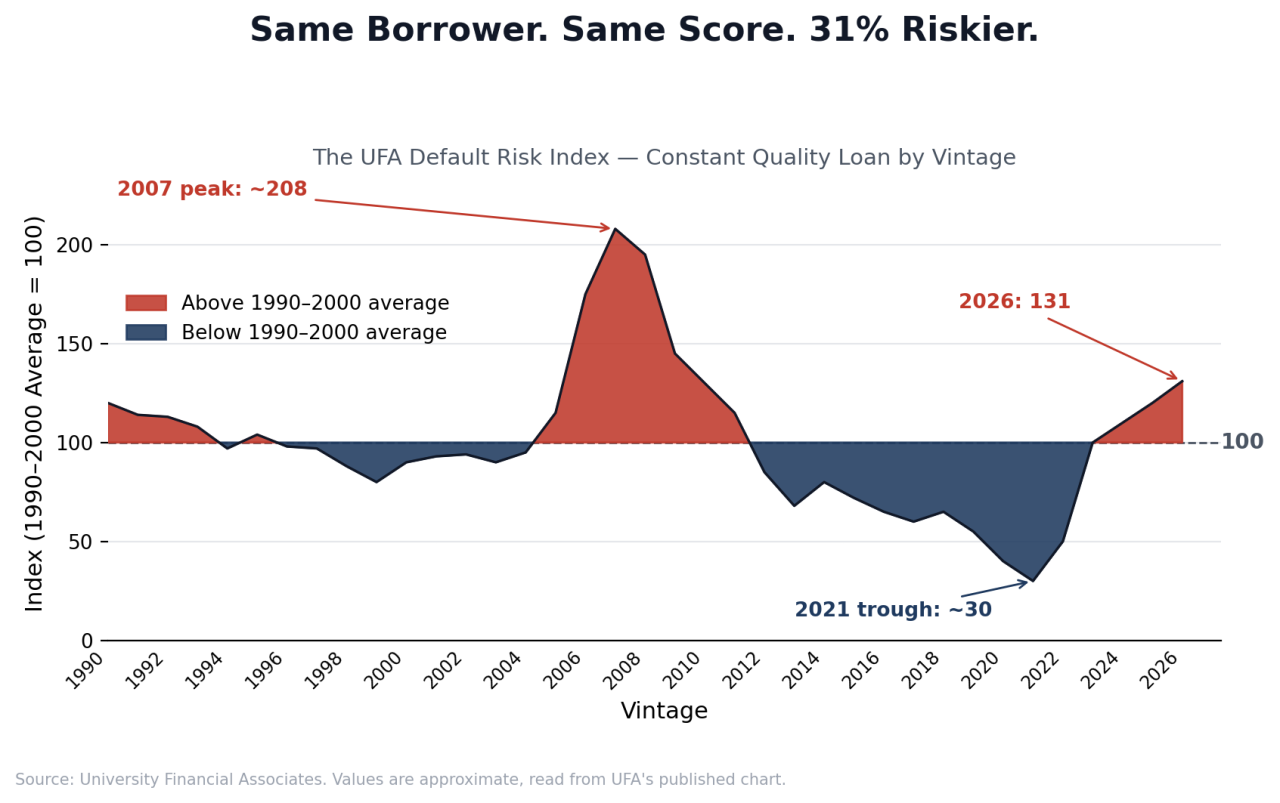
The UFA National Default Risk Index (NDRI) stands at 131. Translate that number and it says something stark: a mortgage originated today, on paper identical to one from the 1990s, is 31 percent more likely to default. Same borrower profile, same loan-to-value ratio, same credit score. Different odds.
That is the headline finding from University Financial Associates' latest analysis.
Here is how the index works. Each quarter, UFA estimates default risk for a newly originated, constant-quality loan (fixed LTV, fixed borrower credit) in every ZIP code in the country. Average those ZIP-level estimates and you get the National Index. The estimates track how predicted local and national fundamentals -- income, employment, house prices -- are likely to move over a mortgage's full thirty-year life.
So why is 131 the number, and not 100?
Start with affordability. Real house prices sit near historic highs. Interest rates are elevated too. Stack those together and the monthly cash cost of owning a home looks worse than it has in decades. A borrower who stretches to make that payment has less room to absorb a bad month, let alone a bad year.
Meanwhile, the ground is shifting under some of these same borrowers. House prices in parts of Florida and Texas have already started to fall. A borrower who bought at the peak in Cape Coral or Austin isn't just paying more each month than a borrower from 1995. They're watching their equity cushion shrink at the same time.
Put the two together and the mechanism is simple. High payments leave no slack. Falling local prices remove the safety net. Add one ordinary life event -- a layoff, a divorce, a medical bill -- and a loan that looked perfectly safe on the underwriting sheet starts to look a good deal riskier. The index is picking up exactly that: not a change in who is borrowing, but a change in the world in which the borrowing happens.
About the UFA National Default Risk Index
The NDRI measures the default risk on newly originated prime and nonprime mortgages, holding borrower and loan characteristics constant. By isolating the economic environment, the index provides a clean read on how current and expected conditions influence mortgage performance. Today’s environment is materially less favorable than in prior years, and the index reflects that shift.
How Investors Use the Index
Because the NDRI is calibrated to historical default rates, investors can easily adjust internal models. A pool with an expected default rate of 1 percent under past conditions would, under today’s environment, be recalibrated to:
1% × (131/100) = 1.31% expected defaults.
About UFA
Each quarter, UFA evaluates U.S. economic conditions and their implications for defaults, prepayments, recoveries, and loan values. The firm’s constant quality framework highlights the central role of macroeconomic stress: recessions erode both borrower resilience and collateral values, while monetary easing tends to mitigate those pressures. Founded in 1990 by two finance professors, UFA brings more than fifty years of combined experience in mathematical modeling and data analysis to the mortgage market.
UFA ForeScore™ ZIP Default Data
UFA’s default and prepayment risk indices are now available for every ZIP code in the country. Research consistently shows that local economic variation accounts for half or more of loan losses. With ForeScore ZIP, lenders, investors, and regulators can incorporate these local dynamics directly into underwriting and portfolio management.