We define place as the evolving economic, housing, and demographic environment that shapes both collateral value and borrower behavior throughout the life of a loan. ForeScore data provides two forward-looking metrics at the ZIP code level for each origination month: one hundred million observations updated quarterly. Scenarios like the "severely adverse" CCAR scenario are also available.
The most important question about any risk variable is whether it adds genuine information beyond what you already measure. ForeScore does, and the evidence is unambiguous.
The table below cross-classifies realized default rates by borrower credit score and ForeScore across 47,000 mortgage originations, with defaults observed over seven years. Neither variable subsumes the other; each explains variation the other leaves unexplained.
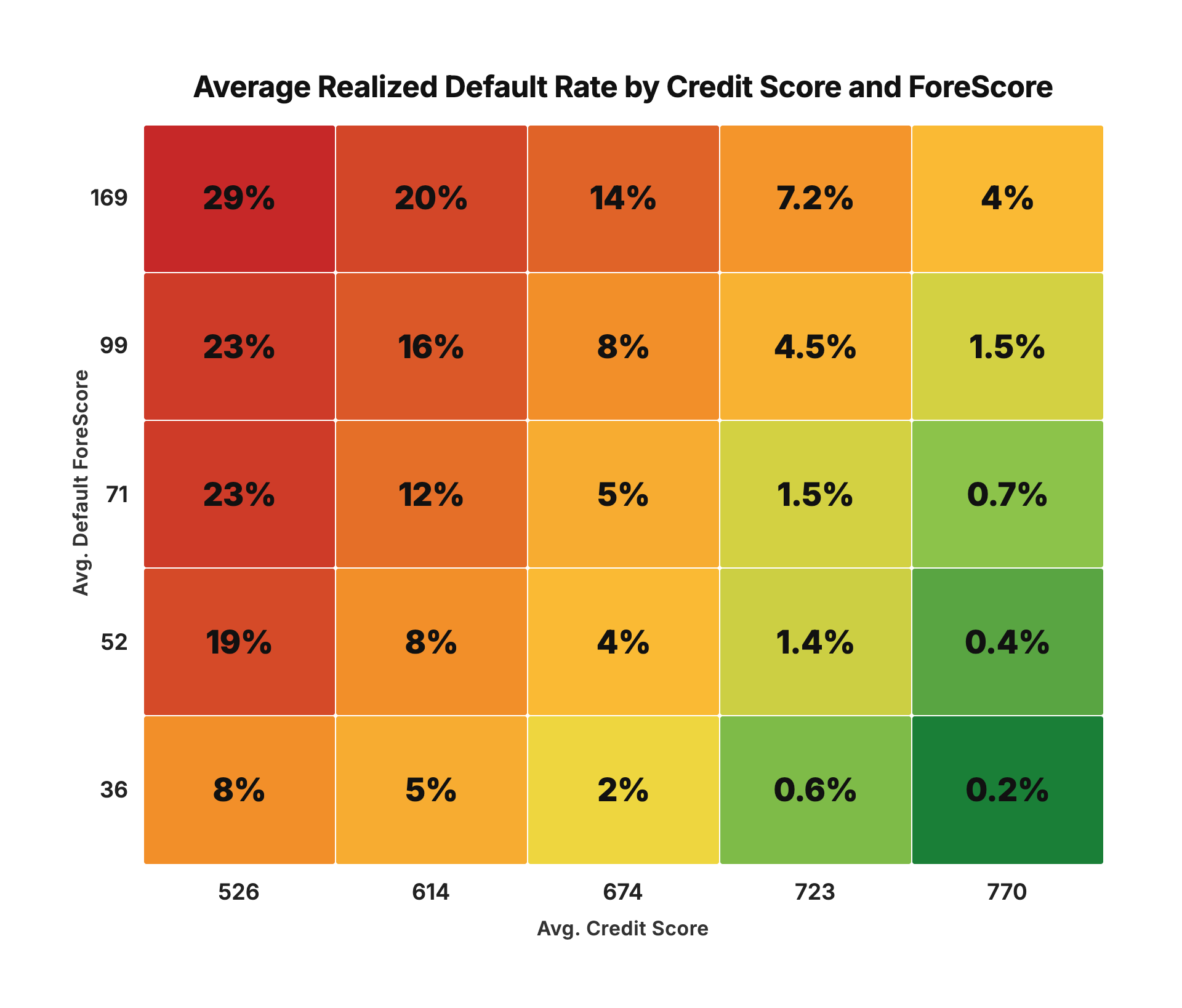
The practical implication is significant. Sensitivity to local conditions results in changes in default rate of over 4-fold across credit score quintiles. For the weakest-credit borrowers in the sample, there is a 21% increase in default rate based on place. Even among superprime borrowers who rarely default, place is a powerful discriminator in managing risk. This is precisely where additional information is most valuable and where ignoring place leads to the most consequential mispricing.
The commercial impact is measurable. In UFA's analysis of more than 30 million mortgage loans, incorporating ForeScore improved pool valuation:
Local economic risk touches every stage of the mortgage lifecycle. ForeScore is built for the institutions that manage it.


ForeScore is built on a proprietary econometric model of local economies, updated regularly. The process integrates economic, housing, and demographic data at the ZIP code level into forward-looking risk scores across the full 30-year mortgage horizon.

ForeScore is delivered as a quarterly data file — ZIP-code-level scores that integrate directly into your existing models and systems. No software to license, no integration project.
First engagements typically begin with a methodology briefing and a sample analysis run against a representative portfolio or loan pool. All engagements are confidential.