Beyond the Borrower: How Place Exposes Mortgage Risk
Dennis Capozza on the three decades of research — and one personal encounter with a 22% mortgage rate — that led to ForeScore.
Abstract
Conventional mortgage underwriting evaluates borrowers and loan characteristics but gives comparatively little attention to the local environments in which mortgages perform. This article argues that place — the evolving economic, demographic, housing, neighborhood, social, and health characteristics of a community — is an independent dimension of mortgage risk. Drawing on three decades of research in urban economics and mortgage finance, it shows how place influences collateral values, borrower behavior, default, and loss severity. Empirical evidence demonstrates that measures of place provide substantial predictive information beyond traditional credit scores.The article describes how these insights led to the development of ForeScore™, a framework for characterizing place and incorporating local conditions into mortgage risk assessment. It concludes that the future of mortgage risk management lies in integrating borrower information with dynamic measures of place and using scenario-based forecasting to evaluate uncertainty.
Introduction
Most discussions of mortgage risk begin with the borrower. Mine began with a housing market.
In 1979 my family and I moved to Vancouver and bought our dream home. It seemed like an ordinary decision. Instead, it became an unexpected lesson in how quickly the economics of homeownership can change in an uncertain world.
Over the next one and a half years, local house prices doubled in real terms. At the same time, the one-year mortgage we had taken out at 12 percent came due for renewal just as Canadian mortgage rates rose toward 22 percent. Suddenly the economics of homeownership looked very different. For anyone buying a home, the monthly cost of owning had nearly quadrupled.
Figure 1: The Vancouver House Price Eruption
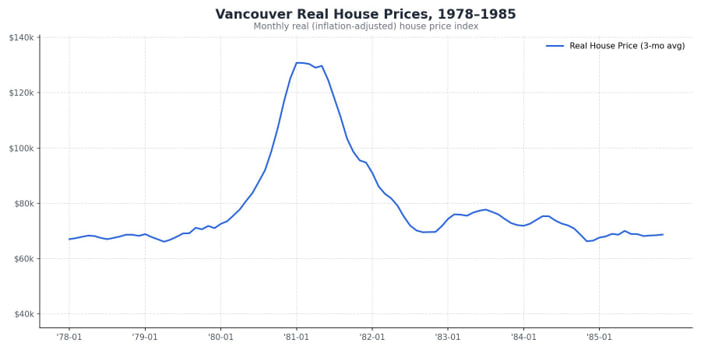
I worked for the same employer, earned the same salary, and lived in the same house. The mortgage contract itself had not changed a single syllable.
The explanation lay somewhere else.
Only much later did I realize what had happened. I wasn't simply living in Vancouver — I was living in a housing market, and that housing market had changed dramatically.
Vancouver was still the same beautiful city. But economically it had become a very different place.
The streets, neighborhoods and houses looked much the same, but the economic reality of living there had changed profoundly. Homeownership that seemed attainable only months earlier was suddenly out of reach for thousands
Figure 2: The Volcker Interest Rate Spike
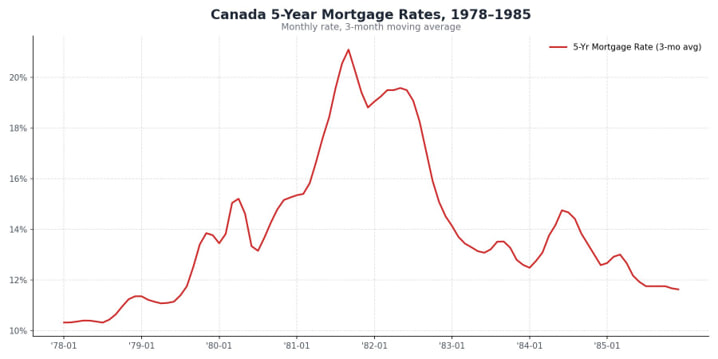
As the head of a household, I had to worry about making the mortgage payment. As a researcher, I became fascinated by a different question.
How could exactly the same mortgage represent such different risks only eighteen months later without the borrower, the mortgage contract, or the house changing?
That question would anchor my research for the next three decades.
The First Question
The first question was deceptively simple.
Was Vancouver unusual, or did other housing markets behave the same way?
As I began looking beyond Vancouver, I discovered something surprising. Cities exposed to the same national economy often behaved very differently. Some experienced dramatic booms and busts while others remained remarkably stable. Interest rates, inflation, and national economic conditions affected everyone, yet their effects varied enormously from one metropolitan area to another.
The common national environment could not explain those differences.
Something local was at work.
Every metropolitan area seemed to have its own economic personality, shaped by local industries, migration, land availability, demographics, and countless other influences. National conditions mattered, but they were filtered through local economic conditions. Similar cities often followed very different paths because their local economies responded differently to the same external forces.
Instead of asking why the national housing market behaved the way it did, I began asking why individual housing markets behaved so differently from one another. The distinction may seem subtle, but it proved to be fundamental.
Figure 3: Diverse Reactions tothe Same National Economic Environment
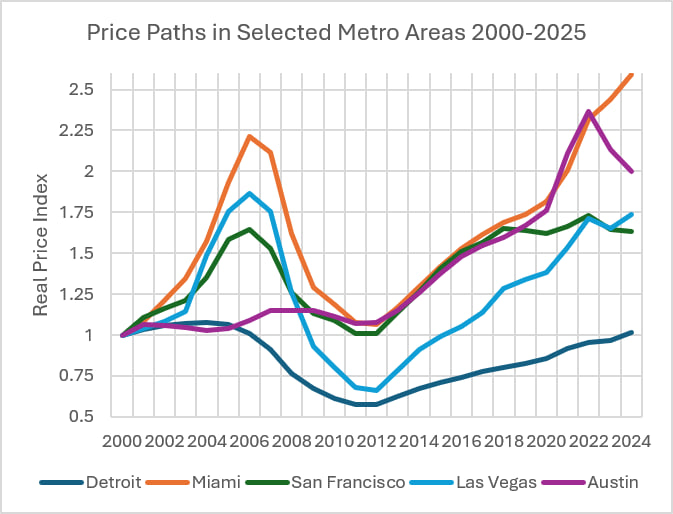
Understanding those differences required looking beyond house prices alone. Prices reveal where a market has been, but they do not explain why it arrived there. To understand local market dynamics, I began examining rents, affordability, employment, population growth, construction activity, and the balance between housing supply and demand. Each variable provided another clue, but no single measure captured the full picture.
Gradually, a broader framework began to emerge. Housing markets are complex adaptive systems in which economic forces, household behavior, financing conditions, and local institutions interact continuously. Small differences in local conditions can produce surprisingly different outcomes over time.
That insight explained far more than Vancouver.
It suggested that what I had experienced was not an anomaly. It was the consequence of living in a particular housing market with its own unique economic characteristics.
At the time, I thought I was studying housing markets.
I didn't yet realize that I was beginning to study what I would eventually come to think of as place.
The Fundamentals of Place
If every housing market had its own economic personality, the obvious question was why.
At first glance, house prices seem to provide the answer. Markets with strong demand experience rising prices; weaker markets do not. But prices are only the visible outcome of much deeper economic forces. Understanding those forces required looking beyond the housing market itself.
Cities are not static. They evolve over decades through countless decisions made by households, businesses, developers, and local governments. Where people choose to live, where firms choose to invest, when farmland is converted to urban uses, how transportation networks develop, and how neighborhoods change over time all influence the long-run value of urban land.
Every one of those decisions is made under uncertainty.
A developer deciding whether to convert agricultural land to residential use cannot know with certainty how rapidly the city will grow, where future employment will concentrate, or whether today's demand will persist. Waiting preserves the option to develop later, when more information is available, but it also risks missing a period of strong demand and rising land values. Developing too soon, on the other hand, commits capital that may earn disappointing returns if growth slows or shifts elsewhere. The decision is valuable precisely because waiting has value. As new information arrives, today's best decision may no longer be tomorrow's best decision.
This realization became the focus of much of my research. Rather than treating land values as simply the outcome of supply and demand, I became interested in the economic process through which cities evolve. Growth, expectations, and uncertainty interact to shape urban structure, and that evolving urban structure determines the long-run value of land and the collateral built upon it.
The work eventually led to a series of papers examining the fundamentals of urban land prices and the role of uncertainty in the evolution of cities. The central idea was straightforward but far-reaching: land values are not determined solely by current economic conditions. They also reflect expectations about the future and the value of preserving flexibility when that future is uncertain.
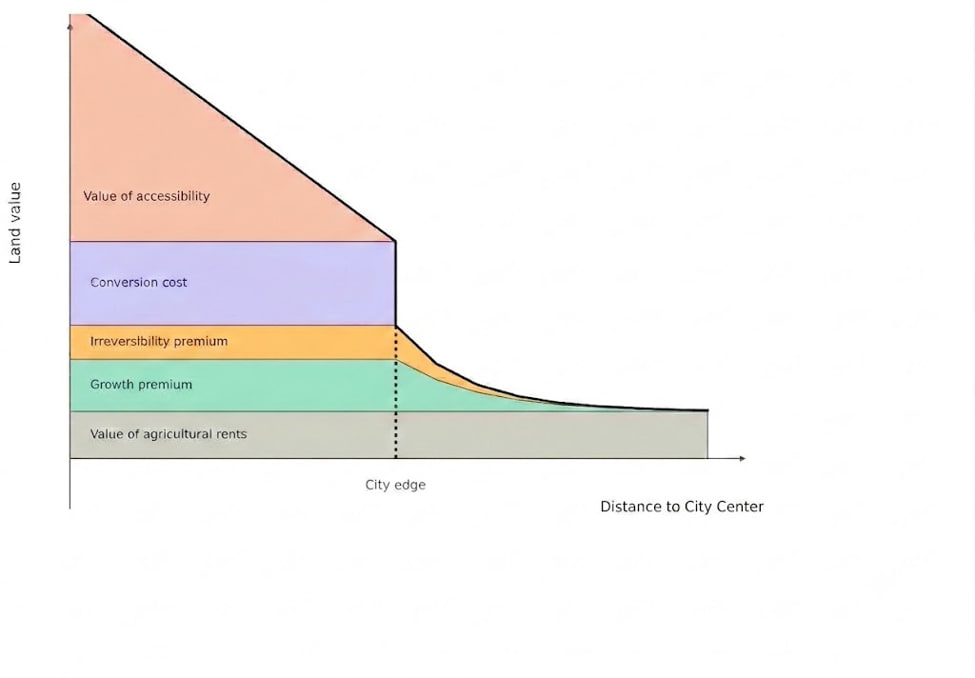
That insight changed the way I thought about housing markets. House prices were no longer simply observations to be explained. They were signals of deeper economic processes operating within local economies.
At the time, I thought I was answering a question about cities.
Only later did I realize I was answering the question that had begun in Vancouver.
Understanding how places evolve proved to be the first step toward understanding mortgage risk.
An Unexpected Connection
For many years, I thought my urban research had little to do with mortgages.
My work focused on understanding how local economies shape the long-run value of urban land. I was interested in growth, uncertainty, and the economic forces that determine why seemingly similar cities evolve so differently over time. Mortgage finance was not the objective.
Then I realized that I had been looking at one side of a much larger problem.
Every mortgage has two essential components. The first is the borrower's promise to repay. The second is the collateral that secures that promise. Although these two components are inseparable in practice, they had largely been studied in different disciplines. Credit analysts focused on borrowers. Urban economists focused on housing markets.
The collateral connected them.
Collateral is where place becomes finance.
The value of a house is not determined solely by its physical characteristics. It depends on the economic vitality of the local market in which it exists. Employment opportunities, population growth, housing supply, neighborhood characteristics, demographic change, and other local forces determine not only what a property is worth today, but how that value is likely to evolve over time.
That realization changed the questions I was asking.
If local economic conditions shape collateral values, shouldn't they also influence mortgage risk? If two borrowers have identical credit profiles but own homes in markets with very different economic prospects, are the risks really the same? And if uncertainty influences the evolution of cities, doesn't it also influence the security on which every mortgage ultimately depends?
These questions suggested that housing economics and mortgage finance were not separate fields after all. They were different perspectives on the same underlying problem.
I had spent years studying the economic processes that create collateral value.
Only later did I realize that collateral is where urban economics and mortgage finance intersect.
Understanding how places create and sustain collateral value was also the first step toward understanding mortgage risk.
Collateral Is Not Static
The more I thought about mortgages, the more I realized that collateral is often treated as if it were a fixed quantity.
A lender orders an appraisal, determines the current market value of the property, and establishes a loan amount based on that estimate. Once the loan is made, the collateral largely disappears from the analysis until the loan is refinanced or a borrower defaults.
That approach is understandable, but it overlooks something fundamental.
Collateral is not static.
The value of a house is not determined once and preserved for the life of the mortgage. It changes continuously as the local economy evolves. Employment expands or contracts. New businesses open while others close.Population grows or declines. Transportation improvements alter accessibility. New construction changes the balance between supply and demand. Neighborhoods improve, stagnate, or deteriorate.
Each of these changes affects the economic environment in which the property exists.
The house itself may be little different from the day the mortgage was originated. The structure ages gradually, perhaps with modest improvements or deferred maintenance. What changes far more dramatically is the value of the land beneath it, reflecting changing expectations about the future of the surrounding community.
This realization was a direct extension of my earlier work in urban economics. If land values are shaped by growth, expectations, and uncertainty, then the collateral supporting a mortgage must also evolve as those forces change.
The implication was straightforward but important.
Mortgage risk cannot be understood solely from information available at origination. Borrower characteristics may remain unchanged, yet the quality of the collateral can improve or deteriorate as local economic conditions change. Conversely, strong collateral can offset some forms of borrower risk, while weakening collateral can magnify it.
The mortgage itself does not change.
The borrower may not change.
The local economy does.
And because the local economy changes, the nature of the collateral changes with it.
This shifted my perspective on mortgage lending. An appraisal provides an estimate of value at a single point in time. Mortgage risk, however, unfolds over years. Understanding that risk requires understanding how the economic environment supporting the collateral is likely to evolve, especially during periods of uncertainty.
Collateral, I came to realize, is not simply an asset securing a loan.
It is a living expression of the local economy.
Mortgages Don't Perform In a Vacuum
Thinking of collateral as a dynamic asset changed the way I thought about mortgage performance.
For decades, mortgage underwriting has focused primarily on the borrower. The emphasis is understandable. Borrowers make the payments. Their income, credit history, debt obligations, and financial reserves provide the first line of defense against default.
Those factors remain essential.
But they are not the whole story.
Borrowers experience financial difficulties within the context of the places in which they live. Housing markets are one part of that environment, but so are local employment opportunities, demographics, neighborhood conditions, and the broader economic forces that shape household resilience.
Consider two homeowners with similar mortgages, comparable credit histories, and identical incomes. Suppose both unexpectedly lose their jobs. On paper, their financial situations appear identical. In reality, they may face very different futures.
If one homeowner lives in a market with rising property values and active demand, selling the house may be a realistic option.Refinancing may also be possible if equity has increased. Financial hardship is still painful, but the local market provides alternatives that may allow the borrower to avoid default.
The second homeowner may have none of those options. If local property values have declined, marketing times have lengthened, and demand has weakened, selling the property may not generate enough to repay the mortgage. Refinancing may be impossible. The same financial shock now has very different consequences. The borrower did not change. The environment did.
The difference is not simply the borrower.
It is the interaction between the borrower and place. Place encompasses the local economic, housing, demographic, and neighborhood conditions that shape both collateral and borrower behavior over time.
This realization led me to a different way of thinking about mortgage risk. Mortgage performance reflects two independent sources of uncertainty. One arises from the borrower. The other arises from place. The borrower's circumstances determine the ability to pay. Place determines the environment in which that ability is tested. Neither dimension can fully explain mortgage performance without the other.
This perspective did not diminish the importance of underwriting. It expanded it. Evaluating a mortgage required understanding not only the borrower but also the local economy supporting the collateral.
That insight also changed the way I thought about default itself.
Default is often described as a borrower decision. In practice, it is frequently the outcome of a changing relationship between the borrower's financial condition and the evolving value of the collateral. The local housing market influences that relationship every day the mortgage remains outstanding.
Years later I would discover that borrowers with nearly identical credit scores experienced dramatically different default rates depending on the places in which they lived.
Once viewed in this way, another question naturally emerged.
If local market conditions influence whether borrowers default, shouldn't they also influence the losses lenders experience when defaults occur?
When Default Is Only the Beginning
Understanding why borrowers default answered only part of the problem.
For lenders and investors, default is not the final outcome. It is the beginning of a new and often uncertain process. The ultimate question is not simply whether a borrower stops making payments, but how much of the outstanding loan balance can ultimately be recovered.
That question shifts attention from the borrower to the collateral.
Once a loan enters foreclosure, the lender inherits all of the uncertainty embedded in the place where that collateral exists. The property must be marketed, sold, and converted back into cash. The outcome depends on much more than the physical characteristics of the house. It depends on the condition of the market into which it is being sold.
In a healthy market, buyers are active, marketing times are relatively short, and transactions provide reliable evidence of value. Even after accounting for foreclosure costs, losses may be modest.
Under stressed market conditions, the situation can be very different. Buyers become scarce, marketing times lengthen, comparable sales become more difficult to interpret, and prices often decline as uncertainty increases.
The lender is no longer simply selling a house. It is attempting to liquidate collateral in a market that is itself under stress.
The distinction proved to be important.
Two mortgages with identical loan balances and similar borrowers can produce very different losses if they are located in different housing markets. The difference is not explained solely by the properties themselves. It reflects the economic environment in which those properties are sold.
This realization reinforced an idea that had been developing throughout my research.
Collateral is more than security for a loan. It is a claim on the future economic value of a place. When that economy is healthy, collateral performs its intended function. When the local economy weakens, the value of that security becomes more uncertain precisely when lenders depend on it most.
The more I studied mortgage losses, the more I came to appreciate that place influences every stage of the lending process. It shapes collateral values before a loan is made. It influences the options available to borrowers when financial difficulties arise. And it largely determines how lenders recover value when defaults occur.
The implications extended far beyond individual mortgages. They affected the behavior of entire portfolios.
If local market conditions influence both borrower outcomes and collateral performance, then they also influence the risk of entire mortgage portfolios.
That realization raised yet another question.
If location plays such an important role in mortgage performance, why wasn't it being measured more systematically?
Once I understood that lenders ultimately own the risk of place, measuring place no longer seemed optional. It became essential.
The Financial Crisis: When Theory Met Reality
For many years, my research had been driven by curiosity rather than urgency.
I wanted to understand why places evolve differently, how uncertainty shapes urban land values, why collateral changes over time, and how those changes influence mortgage performance.
Then came the financial crisis.
Almost overnight, questions that had occupied a relatively small community of housing economists became central to the global financial system. Markets that had appeared stable for years began to unravel. Home prices fell sharply in many metropolitan areas, mortgage defaults increased, and losses spread rapidly through financial institutions around the world.
What struck me most was not simply the scale of the crisis.
It was how differently local housing markets responded.
Some metropolitan areas experienced severe and prolonged declines. Others proved remarkably resilient. Similar mortgage portfolios performed very differently depending on where the underlying properties were located. The patterns I had been studying for years became impossible to ignore.
The crisis reinforced a lesson that had been emerging throughout my research.
Mortgage risk is not determined solely by borrowers or loan terms. It is also shaped by place —the evolving economic environment in which borrowers live and collateral exists. When that environment deteriorates, declining property values, weakening demand, and longer marketing times combine to increase uncertainty at exactly the moment lenders are most dependent on the value of the collateral.
In retrospect, this should not have been surprising.
If local economic conditions influence land values, if changing land values influence collateral, and if collateral determines recovery following default, then widespread changes in local housing markets were bound to have profound consequences for mortgage portfolios.
The crisis did not create these relationships.
It revealed them.
It also exposed an important weakness in the industry's approach to mortgage risk. Borrower information was measured in extraordinary detail. Loan characteristics were carefully documented. Yet the characteristics of place — the environment in which borrowers and collateral interact — were often represented by only a handful of broad indicators, or ignored altogether.
That realization transformed the next question. The challenge was no longer simply to understand place. The challenge was to measure it. Only then could it become part of everyday mortgage decisions.
It was to find a practical way to measure those influences before the next crisis arrived.
From Theory to Practice
The financial crisis demonstrated that place plays a central role in mortgage risk. It also exposed a practical problem.
Knowing that place matters is not the same as being able to measure it consistently.
Lenders, investors, and rating agencies make decisions every year about millions of mortgages. Those decisions cannot rely on broad observations about housing markets or on detailed academic models that require months of analysis. They require measures that are objective, consistent, transparent, and available at the time decisions are made.
The challenge was no longer purely academic.
How could decades of research on housing markets be translated into tools that practitioners could actually use?
That question led me into a different environment.
Working with mortgage investors and rating agencies, especially Fitch, I found that the questions practitioners asked were remarkably similar to the ones that had motivated my research for years. They wanted to understand why mortgages with similar borrower characteristics often performed differently. They wanted to know why losses varied so dramatically across metropolitan areas. Most importantly, they wanted to distinguish between temporary market fluctuations and fundamental differences in the environments in which mortgages perform.
One question emerged repeatedly.
Does place matter as much as the borrower?
Throughout this research, I use the word place deliberately. Place is more than a geographic location. It is the economic, demographic, housing, neighborhood, social, and health environment in which borrowers live and collateral performs. These characteristics are shared by everyone in a community, yet they vary dramatically from one community to another.
If place truly influences mortgage performance, then it should provide information that traditional borrower measures do not.
To test that idea, I compared future mortgage performance using two independent dimensions of risk: traditional borrower credit scores and ForeScore's measure of place.
Table 1: Borrower Credit and Place Are Independent Dimensions of Mortgage Risk
Future mortgage default rates cross-classified by traditional credit score and ForeScore™ demonstrate that place provides substantial information about future mortgage performance beyond borrower credit characteristics alone.
This table illustrates how credit scores and ForeScore™ jointly separate mortgage loans into well-defined risk categories. Rows compare borrowers with similar ForeScores across different credit scores. Columns compare borrowers with similar credit scores across different ForeScores. The data are based on a random sample of 47,000 mortgage originations with realized defaults observed over the subsequent seven years.

The results were striking. Within every credit-score category, future mortgage performance varied systematically across ForeScore™ categories. Likewise, within every ForeScore™ category, borrower credit continued to distinguish risk. Neither measure replaced the other. Together they revealed dimensions of mortgage performance that neither could explain alone.
The table illustrates a simple but powerful idea: mortgage risk has two independent dimensions. One reflects the borrower's financial history. The other reflects the resilience of the place in which that borrower lives. Ignoring either leaves important information unexplained.
These results reinforced the conclusion that had emerged gradually over three decades of research. Mortgage performance reflects both borrower characteristics and place. ForeScore™ was developed to operationalize that second dimension.
The column for borrowers with an average credit score of 631 provides a clear illustration. Traditional valuation treats these borrowers as broadly comparable. Yet their realized default rates range from only 4 percent in the strongest ForeScore™ locations to 19 percent in the weakest—a nearly five-fold difference.
Their credit histories were essentially the same.
Their places were not.
That result confirmed what the earlier research had been suggesting for years.
Mortgage performance depends on both the borrower and the environment in which the borrower and the collateral exist.
Academic research seeks to improve understanding. Practical risk management requires consistent measurement. Bridging those two worlds proved to be both challenging and rewarding.
The objective was never to replace traditional underwriting. Borrower characteristics remain fundamental to mortgage lending. The objective was to complement borrower information with an equally systematic understanding of place, providing lenders and investors with a more complete picture of future mortgage risk.
That realization became the foundation on which ForeScore™ was built.
ForeScore: Operationalizing Place
The cross-tab demonstrated that place contains information about future mortgage performance that traditional borrower measures do not.
The next challenge was practical.
How do you characterize place consistently across thousands of communities, and how do you update that characterization as those communities evolve?
That question became the foundation for ForeScore.
Place cannot be represented by a single statistic. It is the product of many interacting forces: economic conditions, housing markets, demographic trends, neighborhood characteristics, public health, and other local influences that shape both borrower resilience and collateral performance. No single measure captures that complexity. The challenge is to integrate those diverse signals into a consistent description of the environment in which mortgages exist.
ForeScore™ was designed to meet that challenge.
Unlike a credit score, ForeScore™ does not evaluate an individual borrower. Unlike an appraisal, it does not estimate the value of an individual property. Instead, it characterizes the place in which borrowers live and collateral performs.
That distinction is fundamental.
Traditional underwriting measures the borrower.
Appraisals measure the property.
ForeScore™ characterizes the place in which they interact.
Because places evolve continuously, their risks evolve as well. Economic conditions change. Housing markets strengthen or weaken. Demographic patterns shift. Neighborhoods improve or decline. The environment surrounding a mortgage is never static, and understanding that changing environment is essential to understanding long-term mortgage performance.
In many ways, ForeScore™ represents the convergence of several decades of research. The work on urban land values explained how cities create value. Research on local housing markets demonstrated why metropolitan areas respond differently to economic shocks. Studies of collateral and mortgage performance showed how those differences influence default and loss.The financial crisis underscored the consequences of overlooking those relationships.
Each stage of the research answered one question while revealing another.
ForeScore™ was not conceived as a new theory of mortgage risk. It was conceived as a practical way of operationalizing place — a framework that translates decades of research into information that lenders, investors, regulators, and risk managers can use consistently across communities.
Understanding mortgage risk begins with the borrower. Understanding it completely requires understanding place.
Measuring the borrower transformed mortgage underwriting. Measuring place will similarly transform the way mortgage risk is understood.
Janus: Looking Back, Looking Forward
The Romans represented transitions with the god Janus, whose two faces looked simultaneously to the past and the future. Few images better capture the way I now think about mortgage risk.
Looking back has always been an essential part of the journey. Every research project began by trying to understand evidence from the past — housing booms and busts, changing urban structure, mortgage defaults, and financial crises. Those experiences revealed how places evolve, how uncertainty shapes economic decisions, and why mortgage performance differs so dramatically from one community to another.
But understanding the past was never the ultimate objective.
Every mortgage is a decision about the future.
Lenders, investors, and homeowners are not primarily concerned with yesterday's appraisal or last year's default rate. They are making decisions whose consequences will unfold over years, sometimes decades. The central question is not simply what happened. It is what is most likely to happen next.
That realization ultimately shaped the design of ForeScore.
Traditional mortgage analysis asks whether today's borrower qualifies for today's loan. Traditional appraisals estimate the current value of the collateral. Both remain essential. But neither is designed to evaluate how the environment surrounding that mortgage is likely to evolve over time.
ForeScore™ begins from a different premise. Mortgage performance emerges from the interaction between borrowers and place. Place encompasses the evolving economic, demographic, social, health, neighborhood, and housing market conditions that shape both collateral and borrower behavior throughout the life of a mortgage.
Because the future is uncertain, no single forecast can ever be sufficient. A useful framework should allow lenders and investors to explore multiple futures under different economic, demographic, and housing market assumptions. The objective is not to eliminate uncertainty, but to understand how uncertainty changes mortgage risk under alternative scenarios.
In that sense, ForeScore™ is not just about predicting the likely future, but also about asking better questions.
How does mortgage risk change if economic growth slows? What happens if migration accelerates? How will mortgage performance respond if housing supply expands more rapidly than demand? Which communities are likely to remain resilient, and which are more vulnerable to changing economic, demographic, or health conditions?
These are not questions that can be answered by examining an appraisal or a credit score alone.
They require understanding the place in which the mortgage exists.
Good risk management is not about predicting the future with certainty.
It is about being prepared for more than one future.
When I bought my first home in Vancouver, I was trying to understand how the economics of one mortgage could change so dramatically in such a short period of time.
Decades later, I believe the answer remains remarkably simple.
The mortgage did not change.
The place did.
The future of mortgage risk analysis lies in understanding how the two interact over time.