Suppose you could make the exact same mortgage in every ZIPcode in the country. Same borrower, same credit score, same down payment, samerate and terms. Where would that loan be most likely to go bad?
Each quarter, UFA asks that question of its ZIP-codeforecasting model. The answer says a great deal about place. Two borrowers with720 credit scores and 20 percent down can face very different odds of default,depending only on where they buy.
How we build the estimates
Our model forecasts the economy of every ZIP code in the country. It projects local employment, incomes, house prices and related conditions over the entire future life of the loan.
Then we run a simple experiment. We take one loan ofconstant quality: the same borrower, the same credit, the same down payment andthe same terms. We place that loan in each ZIP code and ask how likely it is todefault, given the local economy we expect there.
Because the loan never changes, the borrower plays no part.Any difference in expected default comes from the place alone. The estimatesalso look forward. They reflect future local conditions, not past defaultrates.
We report the result as an index. A value of 1.0 is the historicalnational average, so a ZIP code at 4.0 carries four times the average risk forthe same loan.
Where the risk is highest
The map shows the 100 ZIP codes where our identical loan ismost likely to default. Five ZIP codes tie at the cutoff, so 101 appear.
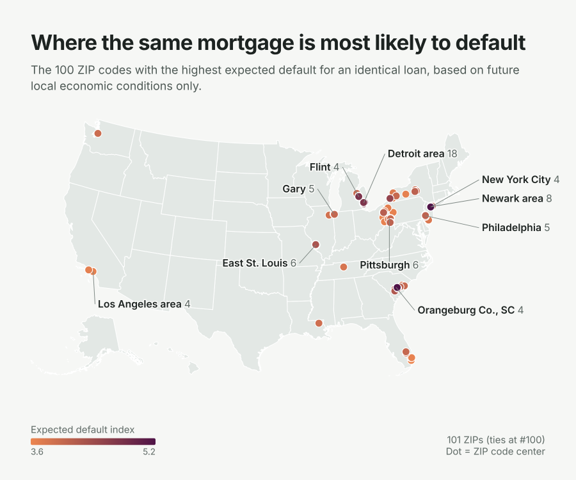
The gaps are large. In the riskiest ZIP codes, the same loanis 4 to 5 times as likely to default as the national average. The risk is alsoconcentrated. Nearly two-thirds of the top 100 sit in just ten counties.
Old industrial metros dominate the list. The Detroit areaalone has 18 ZIP codes, and nearby Flint adds 4 more. Newark has 8. Pittsburghand East St. Louis have 6 each.
Then there is a surprise. Vance, a small town in OrangeburgCounty, South Carolina, ties Newark for the top spot. Three more towns in thesame county make the list.
Why these places
Most of these places share a story—volatile employment andlack of resilience when economic conditions change.
Detroit is the clearest case. The city is heavily dependenton employment in the auto industry, perhaps the second most volatile consumersector after housing. When the auto sector turns down, employees are laid offfor extended periods, stressing households with limited resources.
Housing lasts for decades. When a local economy weakens, itshomes do not disappear. Instead, they lose value. Owners end up with littleequity, and incomes are under strain.
In that setting, a bad year is enough. A lost job or acostly repair can turn a sound loan into a default. A borrower with the sameprofile in a more resilient market could sell the house or refinance. Here,those exits are often closed.
What it means for your portfolio
Credit scores and loan-to-value ratios tell you about theborrower. They tell you nothing about the place. Two loans that look identicalon paper can carry very different risk, depending on where the house sits.
Place risk also moves. When a plant closes or a new employerarrives, a ZIP code's outlook can shift within a few quarters. That is why wererun this experiment every quarter.
So, what's in your portfolio? To see how your loans line upagainst local economic risk, contact UFA.