Where Mortgage Defaults Will Strike First
For years, a housing shortage did something odd: it protected mortgage investors from high interest rates.
Rates rose. Affordability fell. By any normal logic, home prices should have followed. They didn't. Too few homes were for sale, so sellers kept their leverage and prices held firm.
That protection is now breaking down - and it's breaking down unevenly.
UFA's Residential Supply Index tracks how many existing homes are available for sale, market by market. The map it produces shows a country splitting in two. Supply has rebounded across the South and Mountain West. The Northeast and much of the Midwest remain as tight as ever.
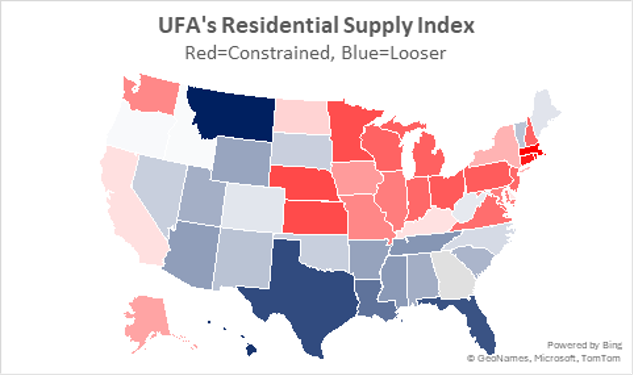
The mechanism is simple: supply and demand, the kind you'd sketch on a whiteboard. Ten buyers chasing five houses gives sellers the upper hand. Five buyers facing ten houses does the opposite: homes linger, sellers cut prices, and each lower sale drags down the next appraisal. More supply means lower prices. There's no way around it.
The Link to Credit
And falling prices are exactly what turns a housing problem into a credit problem.
Equity is a homeowner's cushion, and it's also the mortgage investor's first line of defense. A borrower who loses a job but owns 30 percent of the house outright can sell it, pay off the loan, and walk away clean. A borrower with no equity has far fewer options. One who owes more than the house is worth has almost none.
Follow that logic to its conclusion, and the UFA map becomes a forecast. The South and Mountain West should feel the pressure first, because that's where supply has come back hardest - and where the price cushion protecting lenders is thinnest.
The Northeast and Midwest face a different problem entirely. Housing there is still brutally unaffordable, but scarcity keeps propping up prices. That's worth pausing on, because the two problems get confused constantly: bad affordability and falling prices are not the same thing. A market can stay expensive for a long time simply because nobody is building - or because nobody who owns a house is willing to sell it.
That distinction should matter more than it currently does to anyone pricing mortgage credit risk.
The Full Picture
The industry's instinct is to watch the borrower - credit score, debt-to-income, loan-to-value, whether they still have a job. All useful. All incomplete. Every mortgage has two sides: a borrower and a house. Watch only the borrower, and you'll miss the risk building on the other side of the ledger.
When supply rises, collateral weakens. When collateral weakens, defaults become both more common and more expensive to clean up.
Implication for Mortgage Investors
The next mortgage credit cycle won't hit the whole country at once. It rarely does. The supply map just tells you where to start looking.